




What's the Difference Between a Proxy and a VPN

The word 'proxy' shows up in plenty of circumvention tool descriptions, and rarely gets explained. Here is what a proxy actually does, how it differs from a VPN, and whether it protects your privacy at all.



A proxy is a middle server that forwards traffic on your behalf: a request goes to the proxy first, the proxy sends it on to the destination, and the destination sees the proxy's address, not yours. That is the one thing every proxy does, and everything else about it is a variation built around that single fact.
Under the broad label of "circumvention tools," proxies and VPNs get mentioned in the same breath constantly. They do solve some of the same problems, but they differ a great deal in coverage, whether they encrypt anything, and how much setup they demand. The word sounds simple enough, yet it covers several different things: a proxy field buried in phone settings, a browser extension, and what the circumvention-tool scene calls an "airport" (机场) service are all the same underlying technique wearing different packaging. This article covers the proxy on its own first, then sets it against a VPN, and leaves the choice to your own situation.
One misunderstanding is worth clearing up early: installing a proxy does not make everything safe. A proxy solves exactly one problem, namely which address a site sees. Account security and whether content can be read by someone in the middle are entirely different problems, covered further down.
What a proxy actually is
A proxy is a server whose whole job is forwarding. A request leaves the device, passes through the proxy, and the proxy fetches the destination on your behalf before relaying the result back. Throughout that exchange, the destination site sees a connection coming from the proxy's address, never from the device itself.
Think of it like asking a friend to pick up a parcel at the counter for you. The counter only ever deals with "the friend"; it never learns who the parcel is really for. A destination site sees exactly that friend-at-the-counter layer, not the device behind it.
That forwarding can happen at different levels: system-wide, or scoped to a single app or browser. That is also why "I set up a proxy" does not automatically mean "all my traffic goes through it" — how much gets covered depends on where the setting was made, not on the act of installing one.
A proxy is not a protocol, either. A protocol governs how data gets packaged and transported. What a VPN protocol actually is covers that layer on its own; it solves a problem with no overlap with what a proxy does, even though the two words often turn up in the same sentence.
How a proxy differs from a VPN
The two get confused mainly because both can change the address a destination sees. How they get there, and how much they cover, are completely different.
| Comparison | Proxy | VPN |
|---|---|---|
| Coverage | Usually only the app or browser it was set up in | Usually the whole device's traffic |
| Encryption | Most proxies carry none | Encrypts the whole tunnel by default |
| Typical setup | Type a server address and port into a system or app setting | Install a client, sign in, tap connect |
Here is a concrete case: if you only want one browser to look like it is somewhere else for one site, while everything else connects normally, a proxy is enough, and lighter to set up. If you want every app on a phone or laptop to change its exit point at once, including background sync and the system's own app store, that is the scope a VPN covers and a proxy cannot reach. In short, a proxy points one app down a different road; a VPN swaps the exit for the whole device. The fuller feature comparison lists more angles than this article covers.
Which one actually fits what you need
Neither replaces the other; they simply suit different situations. Checking one page occasionally, with no login involved, and some patience for setup — a proxy is enough, and lighter besides. Daily use, anything involving a logged-in session, wanting the whole device handled at once — a VPN is the less fiddly choice, since installing it covers every app on the device at once instead of configuring them one by one.
Some people run both: a VPN for daily, whole-device use, and a proxy kept around for the odd case that only needs a quick address change without reconnecting the whole VPN. That is not a contradiction, as long as you keep straight what each layer is responsible for, and never hand anything sensitive, like an account password, to the more loosely configured one.
Where you actually run into a proxy
The most common spot is that "proxy" field in system network settings, where you type a server address and a port number by hand. That only affects whatever the system layer can actually intercept; some apps bypass the system proxy entirely and keep their own separate connection settings, so filling in the system proxy does not mean those apps follow along.
Browser-extension proxies are common too. Once installed, they only handle requests from that one browser; switch to another app or another browser and you are back to the original address, unlike a VPN, which takes over every exit point at once.
Phones have something similar, usually tucked into the Wi-Fi details screen and labelled "Proxy" or "HTTP Proxy." Filling it in works much like on a computer, except it only applies to the Wi-Fi network you filled it in for — switch networks and you have to type it in again. That is exactly why running a proxy on mobile is more of a hassle than running a VPN: the setting does not usually follow you when the network changes.
What the scene calls an "airport" (机场) service is, more often than not, also a proxy node account: you buy it, then find your own client software to import it into and maintain your own routing rules. VPN vs airport proxy services covers that architectural gap in detail — an airport service and a proxy are not two unrelated things, just two names for the same layer.
Does a proxy decide what content I see
Changing the address through a proxy changes what a site guesses about roughly where you are, which in turn can change which region's content library it shows you. What an IP address actually is covers the link between an address and that regional guess in full; the short version here is that whether a proxy unlocks region-locked content depends entirely on whether the destination judges purely by that one address, rather than stacking on other signals like where the account was registered or which payment method is on file.
A common example is a content platform that serves a different library by region: switch proxies, and the platform assumes the connection is coming from somewhere else, so the list changes. That genuinely works, provided the platform really does judge by the connection address alone, with nothing else layered on top. It also explains the odd case where the content list appears to change while the account itself still says "not available in your region" — the two checks do not read the same signal, and a proxy only changes one of them.
What a proxy does not protect
A proxy is not a full privacy package. It solves exactly one thing, which address a site sees, and everything below sits outside what it covers.
- It does not change who you are to the account itself — whichever account you log into, that site keeps its own record of it regardless of whether traffic passed through a proxy.
- It is not necessarily encrypted — most proxies only forward, they do not encrypt content, so another device on the same Wi-Fi can, in theory, still read unencrypted traffic.
- The proxy operator itself can see what passes through it — if that traffic carries no extra encryption, whoever runs the forwarding can, in principle, read the content, so routing through an unknown free proxy hands that trust to a stranger.
- It does not cover apps you never configured — set it up in a browser only, and every other app keeps using its original route; it does not follow along just because the browser's address changed.
- Changing the address is not the same as disappearing — some sites actively detect proxy-like addresses and refuse service or demand extra verification. That is not a flaw in the proxy; it is a barrier the destination chose to set, and it is a reminder that a changed address is not automatically an invisible one.
In summary
A proxy is a middle server that forwards traffic, changing the address a site sees, usually only for whichever app it was configured in, and usually without encryption. A VPN solves the fuller version of the same problem: the whole device, encrypted by default, set up once instead of app by app.
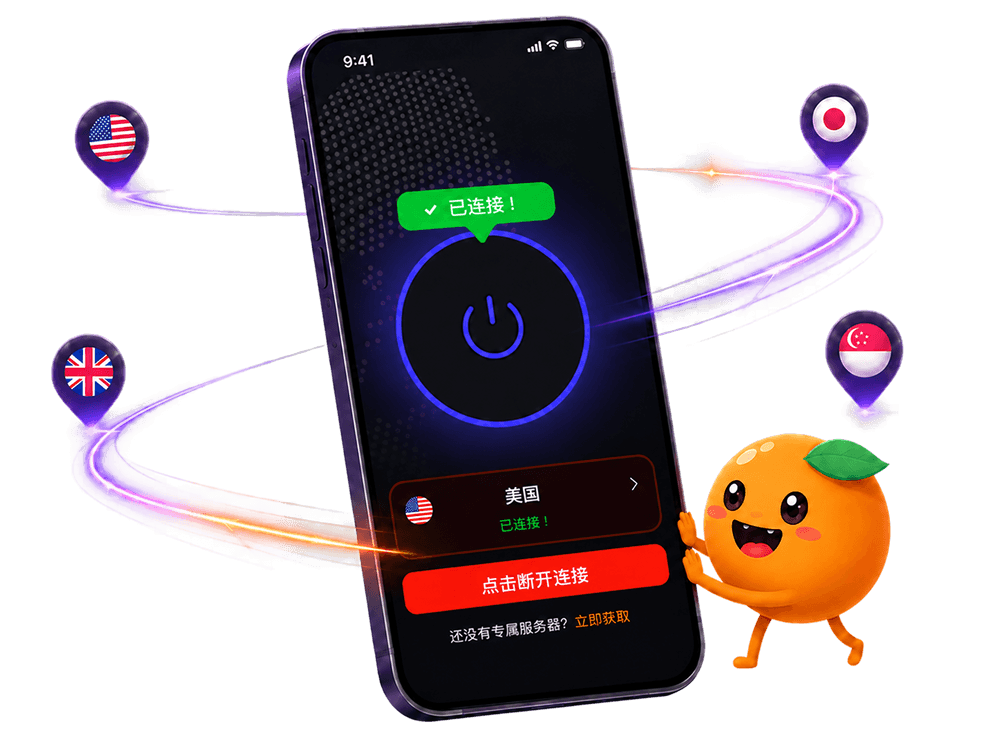
As a VPN product, FastOrange lets one subscription cover multiple devices at once, with no need to type a proxy address into each app separately, and encryption covering the whole device by default. See what it does for the fuller picture. Every registered account gets free trial time daily, so try it once and feel the difference against configuring a proxy by hand.

 High speed
 Millions of users
 24/7 Support
Get the Fast Orange App
One App. Every Platform. A More Stable Connection.
Available for Windows, macOS, Android, and iOS. Use One Account Across All Your Devices and Start with a Free Trial.
High speedMillions of users24/7 SupportDownload Fast Orange
 Choose your platform
Download Fast Orange
Switch between Windows, Android, iOS, and macOS